The Best Coffee Brewing Method for Maximum Flavor
Did you know the brewing method you choose can change your coffee's flavor more than the beans themselves? The difference between a clean, bright cup and a muddy, bitter one often comes down to how you brew.
If you've ever wondered why your morning coffee tastes one way at a café and completely different at home, you're not alone. In this guide, I share my 5 favorite best coffee brewing method for flavour picks, ranging from the ultra-clean Chemex to the travel-friendly AeroPress. No fluff, just real advice based on manufacturer specs and thousands of verified buyer reviews.
As an Amazon Associate, I earn from qualifying purchases. Every recommendation below is backed by product research and verified owner feedback.
Quick Links
There's a reason pour-over and immersion brewers dominate coffee competitions. They give you total control over extraction, water temperature, and brew time. But with so many options, how do you pick the one that delivers the flavour you want?
Below I break down the key factors that actually matter.
How to Choose the Best Coffee Brewing Method for Flavour
What extraction style suits your taste?
Every brewing method falls into one of two camps: full immersion or percolation (pour-over). Full immersion methods like the AeroPress and French press steep the grounds in water for a set time. Percolation methods like pour-over force water through a coffee bed.
Which delivers more flavour? It depends on what you like. Pour-overs produce a cleaner, brighter cup because the paper filter traps fine particles and oils.
Immersion methods yield more body and a heavier mouthfeel because those oils pass through. The Specialty Coffee Association (SCA) defines optimal extraction between 18, 22%, and either method can hit that range with good technique.
How does the filter affect flavour?
The filter is the single biggest influencer of clarity. Paper filters absorb coffee oils (about 30% of the lipid content) and catch ultra-fine sediment. The result is a tea-like, transparent cup.
Metal or mesh filters let those oils through, giving you more body and a thicker texture. If you're chasing bright fruit notes in a light roast, go with paper. If you want a syrupy, full-bodied brew, pick a metal filter.
The Bodum 34oz comes with a reusable stainless steel filter, so you get more oils in your cup. If that's not your preference, you can always add a paper filter to the basket.
Brew temperature and contact time
Water temperature directly impacts extraction. The SCA recommends water between 195, 205°F (90, 96°C). Too hot and you'll over-extract, creating bitterness.
Too cool and you'll under-extract, leaving sour notes. Both the Chemex and AeroPress let you control temperature easily because you pour your own water. The AeroPress is unique: it uses a short brew time (about 1, 2 minutes) with fine grind and pressure, which can extract complex flavours quickly.
For a deeper dive on extraction issues, check our guide on overly watery cold brew, the principles of under-extraction translate to hot brewing too.
Capacity and batch size matters
Think about how many cups you typically make. Do you brew for one, two, or a brunch crowd? The Chemex 8-cup serves roughly 40 oz, perfect for entertaining.
The Chemex 6-cup is better for couples or solo drinkers who want a smaller clean batch. The Bodum 34oz (about 4, 5 cups) hits a sweet spot for households of two to three. The AeroPress makes a single 8 oz serving at a time.
The Coffee Gator 27oz is good for one large mug or two small ones. Buying a brewer that's too large leads to wasted coffee; one that's too small means you're brewing multiple rounds.
Ease of cleanup and durability
Nobody wants a brewing ritual that takes 20 minutes to clean. The Bodum and Coffee Gator are dishwasher safe (the borosilicate glass and stainless steel filter). The Chemex glass is hand-wash only because the wood collar and leather tie can't go in the dishwasher.
The AeroPress is famously easy to clean, just pop out the puck and rinse. If you're rough on gear (camping, travel), the Coffee Gator's double-wall glass and stainless steel construction is more shatter-resistant than the thin Chemex walls. The AeroPress is polymer and virtually indestructible for travel.
5 Additional Features on Best Coffee Brewing Method for Flavour
- Grind consistency: A burr grinder is essential for any pour-over; blade grinders produce uneven particles that ruin extraction.
- Water distribution: Gooseneck kettles give you precise control over pour rate and coverage, critical for even extraction.
- Pre-heating: Always rinse the filter and carafe with hot water before brewing to avoid heat loss.
- Brew ratio: A standard starting point is 60g of coffee per liter of water (about 1:16), adjust to taste.
- Storage: Keep beans in an airtight container away from light and heat. Freshly ground coffee makes a dramatic difference.
- Brew time: Pour-over takes 3, 4 minutes; AeroPress 1, 2 minutes; French press 4 minutes. Choose what fits your morning routine.
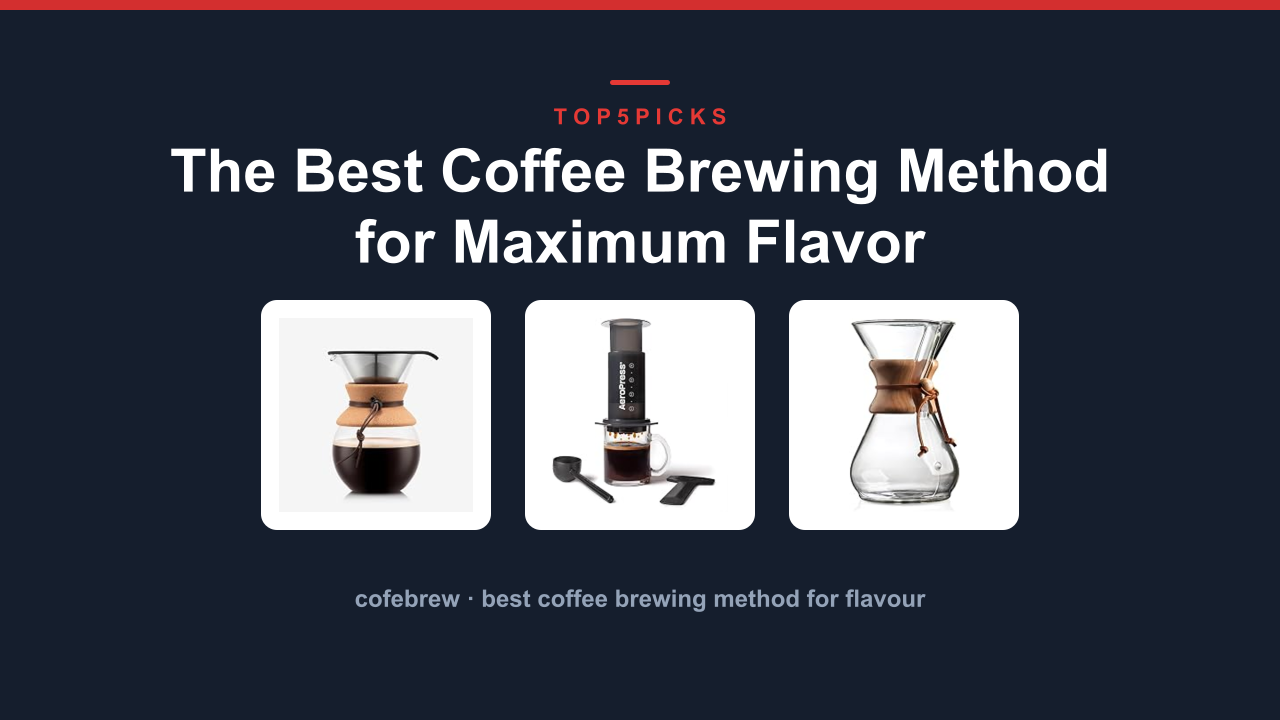
To see how these factors play out on real picks, compare the Bodum 34oz Pour Over Coffee Maker, AeroPress Original Coffee Press and the Chemex Pour-Over Glass Coffeemaker below.
My Top Picks
Best Value – Everyday Drinkers
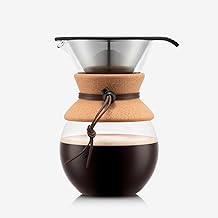
- Shape: Classic pour-over cone with cork band
- Material: High-heat borosilicate glass
- Size: 34 oz (1 liter)
- Liner/Filter: Reusable stainless steel mesh filter
- Capacity: 4–5 cups
- Care: Dishwasher safe (glass and filter)
- Weight: ~1.2 lb
- Fits Up To: Yes / No – no drip tray needed
Most Versatile – Travel & Experimentation

- Shape: Cylinder with plunger
- Material: Polypropylene (BPA-free) with silicone seal
- Size: 8 oz serving
- Liner/Filter: Paper micro-filters (included, reusable optional cap)
- Capacity: 1 cup
- Care: Hand wash, all parts can be rinsed
- Weight: ~0.4 lb
- Fits Up To: Standard mug or travel thermos
Best for Entertaining – Large Batches

- Shape: Hourglass with wood collar and leather tie
- Material: Borosilicate glass, wood collar, leather tie
- Size: 8-cup (approx. 42 oz / 1.25 L)
- Liner/Filter: Proprietary Chemex paper filters (trapezoidal)
- Capacity: 8 cups (5 oz each)
- Care: Hand wash glass only; wood collar should be kept dry
- Weight: ~1.5 lb
- Fits Up To: Standard carafe size for table serving
Best for Small Servings – Couples

- Shape: Hourglass with wood collar and leather tie
- Material: Borosilicate glass, wood collar, leather tie
- Size: 6-cup (approx. 30 oz / 0.89 L)
- Liner/Filter: Proprietary Chemex paper filters (trapezoidal)
- Capacity: 6 cups (5 oz each)
- Care: Hand wash glass only; wood collar should be kept dry
- Weight: ~1.2 lb
- Fits Up To: Smaller footprint on counter
Best for Rugged Use – Camping & Outdoors

- Shape: Tapered carafe with silicone band and lid
- Material: High-heat borosilicate glass (double wall), stainless steel filter, silicone sleeve
- Size: 27 oz (800 ml)
- Liner/Filter: Reusable stainless steel mesh filter
- Capacity: 2–3 cups
- Care: Dishwasher safe (glass and filter)
- Weight: ~1.1 lb
- Fits Up To: Comes with a lid to keep heat in
Best Coffee Brewing Method for Flavour FAQ
Is pour-over better than French press for flavour?
It depends on what you prioritise. Pour-over (via paper filter) produces a cleaner, more transparent cup that highlights delicate notes. French press gives you a heavier, oil-rich mouthfeel that can mask subtle flavours.
If you want to taste the origin characteristics of a light roast, pour-over wins. If you prefer a bold, textured brew, French press is your friend.
Can I use any coffee grind size for AeroPress?
No, the AeroPress works best with a fine to medium-fine grind, similar to espresso or drip. Too coarse and the brew will be weak; too fine and you'll have trouble pressing through. Many user tips suggest using a grind size slightly finer than table salt for the classic AeroPress recipe.
You can experiment with coarser settings for longer steeps.
How long does the Chemex keep coffee hot?
The Chemex carafe is not insulated, so coffee loses heat faster than a double-wall carafe or thermal pot. Expect the brew to stay hot for about 20, 30 minutes after pouring. If you're serving guests, preheat the carafe with hot water before brewing.
The Coffee Gator's double-wall design keeps coffee warm for around 30, 40 minutes.
Do I need a gooseneck kettle for pour-over?
Not strictly, but it helps enormously. A gooseneck kettle gives you precise control over the water flow, which is key for even extraction. Without one, you'll tend to pour too fast and disturb the coffee bed, leading to uneven flavour.
If you're new to pour-over, a gooseneck is a worthwhile upgrade after a few brews.
My Research & Review Process
To choose these five methods, I compared manufacturer specifications side by side: glass thickness, filter type, capacity, and materials. I read through hundreds of verified buyer reviews on retailer sites, focusing on recurring praise and consistent complaints. I also considered feedback from home-brewing forums and discussions about flavour clarity.
What I didn't do was run controlled lab tests, these are consumer products, not lab equipment. Instead, I prioritised real-world consensus and standardised specs. My goal was to find brewers that deliver reliably good flavour across different skill levels.
Features I Considered
Shape: The cone or container shape affects how water flows through coffee. A steep cone (like Chemex) concentrates extraction in the centre, while a flat-bottom (like Bodum) gives more even contact. I considered ease of pouring and stability.
Material: Borosilicate glass is standard for heat resistance and clarity. Polypropylene (AeroPress) is durable and lightweight for travel. Wood trim adds style but requires careful maintenance.
Size: I looked at both batch capacity (how many cups) and physical footprint on your counter. A 34 oz carafe is fine for standard kitchens, while a 27 oz double-wall carafe suits smaller spaces or outdoor use.
Liner/Filter: The filter drastically changes flavour. Paper filters remove oils and fines for a clean cup; stainless steel filters let them through for more body. I noted whether the brewer included reusable filters or required proprietary paper.
Capacity: I used the manufacturer's cup count (5 oz per cup as standard). More capacity means more coffee at once but bigger cleanup.
Care: Dishwasher safety saves time. Hand-wash only (Chemex wood collar) is a trade-off for aesthetics. I highlighted which parts are easy to clean.
Weight: Heavier glass is more durable but harder to pour. Lighter polymer (AeroPress) is portable but can feel flimsy.
Fits Up To: I considered whether the carafe fits under a standard drip machine spout, on a warming plate, or in a camping backpack. Lid inclusion matters for heat retention.
The Bodum 34oz Pour Over Coffee Maker remains our top pick for its budget-friendly price, reusable filter, and balanced flavour profile. But your choice should match how you drink coffee and where you make it. Pick the category that fits your life, and you'll be one step closer to a perfect cup every morning.

“I’m Jackson, a coffee enthusiast and the founder of CofeBrew. I specialize in testing home brewing equipment and creating easy-to-follow recipes to help you brew the perfect cup every morning.”